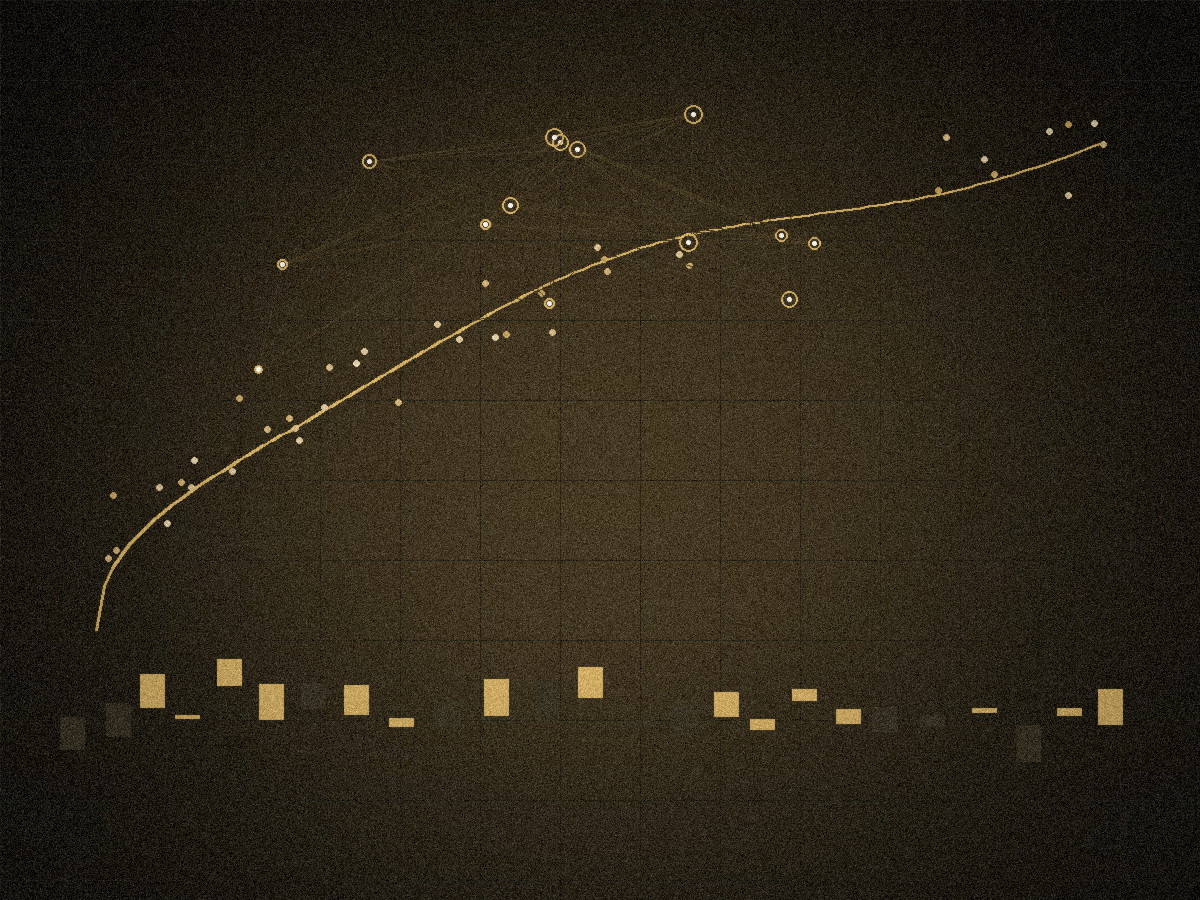
There are two kinds of yield in the market, and most people confuse them. The first is the yield you are paid to hold a bond — a coupon, a fixed percentage, the price of waiting. The second is the yield you take from a trade — the spread you pocket between two prices that should be equal and are not. One is the income of an owner; the other is the income of a market-maker. Meridian builds the second, and the second is worth far more.
Statistical arbitrage is the business of finding the two prices that should meet and capturing the gap between them. It is not a bet on direction; it is a bet on convergence. Two names, two markets, two moments — and a model that knows they are wrong apart. The edge is not in being right about the world; it is in being right about the distance between two prices that the world has simply not yet reconciled.
“A direction is a thesis. A spread is a fact. We trade the fact, and let the thesis argue itself out.”
Where the edge lives
When everyone is crowded onto the same thesis, the thesis is free — it is priced in, and there is nothing left to take. The edge moves to the places the crowd does not look: the yield curve between two markets that trade in different currencies, the spread between a bond and its underlying, the gap that opens when a market is slow to reconcile two prices that a faster reader knows are one. That gap is small, it is crowded by no one, and it is exactly what an engine built to read a hundred markets at once is for.
So the edge lives where the crowd does not go, and it lives in the engine. A model is only as good as the markets it can see at once. The fund that watches five names at a time will always lag the fund that watches five thousand and moves on the first that drifts. That is not a question of talent; it is a question of scale, and scale is a thing Meridian owns.
Why the yield is the business
The coupon is paid once, on a schedule. The spread is taken ten thousand times a day, every day, in sizes too small to matter to one fund but large to matter to a house. Consume enough of them, with enough discipline, and the spread becomes a yield — a steady, uncorrelated, quietly compounding yield that pays without asking the market for permission. That is the business. Not a thesis about where prices go, but the harvest of the gaps they leave behind.
Most firms sell a story about which way the world is heading. We simply are — and our story is written in ten thousand small convergences a day, each one a fraction of a spread, each one ours to keep.